Ephemeral sketch


Schedule for Mindful Presence
While managing the department at Arad Communications, I realized I needed to change the way I worked. At the time, I was mostly working and sleeping. A new department was being built, and I felt I couldn’t loosen my grip for even a moment, as though everything would collapse if I did. How I eventually moved beyond that belief is another story, but since then I’ve learned to work with a weekly planning system rooted in long-term goals, while continually refining both my workflow and my direction.
Recently, while reviewing my goals for the coming week, I suddenly noticed that the thing I considered most important was precisely the one for which I set no goals at all. I practiced mindful presence and meditation, yet neither appeared in my schedule.
As I write this now, I realize that wasn’t accidental. Beneath it lay an old inner conflict: can the state of consciousness be treated like any other project, with goals, milestones, and measurable progress? And beneath that, an even deeper question: does consciousness itself actually develop?
Western thought generally does not view consciousness as evolving. Intelligence is assumed to be relatively fixed, while development is understood mainly in psychological terms: changes in perception, interpretation, behavior, and habits. The contents of the mind change, but the perceiving and cognitive mechanisms themselves are assumed to remain essentially the same.
Eastern traditions take a more radical view. In early Buddhism, freedom from fear requires a transformation of consciousness itself. Buddhism distinguishes between ordinary and higher states of consciousness according to the mental states that arise within them. In higher states, anger, craving, restlessness, and lethargy lose their grip. Even wholesome qualities such as attention and concentration take on an entirely different depth and intensity.
Early Buddhism not only asserts that consciousness can evolve, but also offers a path for that transformation: the Noble Eightfold Path, right speech, right action, right livelihood, right effort, and more. Ultimately, transformation depends on effort.
Yet even the word “effort” is misleading. This is not struggle or self-coercion, but the careful cultivation of awareness: preventing unwholesome states from arising, releasing those already present, nurturing wholesome states, and strengthening them once they appear.
Later Buddhist traditions challenged this very approach. Although early Buddhism questions the existence of a separate and enduring self, the pursuit of enlightenment through disciplined effort can itself reinforce the illusion of an “I” striving to improve.
The belief that there is someone who must become something else only deepens the illusion that the ego offers, what early Buddhism calls avidya, ignorance.
My first encounter with this approach came while reading Satyam Nadeen’s book From Onions to Gems: A Journal of Awakening and Redemption. Nadeen describes his awakening while imprisoned in one of America’s highest-security prisons, surrounded by violence, fear, and constant noise. In that unbearable environment, he immersed himself in Advaita Vedanta texts.

Advaita, a school of Indian philosophy that emerged around the 8th century CE, teaches that Brahman is the ultimate reality: limitless, unchanging, beyond perception. The true self, Atman, is not separate from Brahman. “Atma Brahma Asmi”, “I am Brahman”, is the phrase most commonly identified with Advaita.
From this perspective, freedom is not something to attain. It already exists. The only obstacle is ignorance, and ignorance dissolves not through action, but through direct understanding.
Not conceptual understanding, but immediate recognition:
I am not the body, not the story, not the character.
I am consciousness itself, the witnessing presence.
Reading Nadeen felt like colliding with a wall. “There is no one who decides and no one who acts,” he wrote, and I could not grasp what he meant. If not me, then who makes decisions?
The idea triggered enormous resistance in me. I was not ready to relinquish the identity built around achievement, growth, effort, and becoming.
Another fear followed close behind: if there is no separate “I”, should I simply stop trying altogether? Follow every impulse? Abandon all discipline?
I raise these questions not as philosophy, but because they shaped a very practical dilemma: can mindful presence become part of a structured daily life, or does turning it into a goal already distort it?
For a time, influenced by Advaita teachings, I experimented with “doing nothing,” including giving up efforts to work with harmful habits. I let impulses lead. It did not bring much freedom. On the contrary.
Today, I see the value of both mindful practice and right effort, though cautiously. Early on, I discovered how easily spiritual work itself becomes another ambition of the ego, another project of achievement and ego-expansion. When that happens, the path quietly reproduces the very patterns it seeks to dissolve.
There is nothing wrong with wanting to create, succeed, or grow. Human beings are naturally driven toward movement and expression. The deeper question is where action arises from. Is our sense of self tied to outcomes? Are we trapped in self-judgment, guilt, and endless anticipation of the future? Most importantly, does our obsession with becoming pull us away from the immediacy of being?
Much water has flowed through the Yarkon River1 since then. Over time, I learned to shape goals that emerge from a more authentic movement rather than from the need to become someone valuable. I learned softness, patience, and a gentler relationship with failure. Most of all, I learned to let go of the demand for enlightenment, preferably by next week.
Today I read Advaita differently. I understand more deeply what Byron Katie means when she says:
“We never make a decision. When the time is right, the decision makes itself.”
The separate “I” is not a central controller steering the system. Thoughts appear, impulses appear, actions unfold, and awareness witnesses them. The sense that “these thoughts are mine” or “this body belongs to me” is itself part of the illusion.
For this reason, traditions such as Zen and Dzogchen emphasize non-doing. Awakening is not something to be achieved in the future. It exists only here, in the unobstructed immediacy of present awareness. The attempt to grasp or attain it can itself become another escape from the present.
And yet, even these traditions rely on practice: meditation, study, dialogue, disciplined attention. Without some cultivation, consciousness tends to fall back into automatic reactions and habitual patterns.
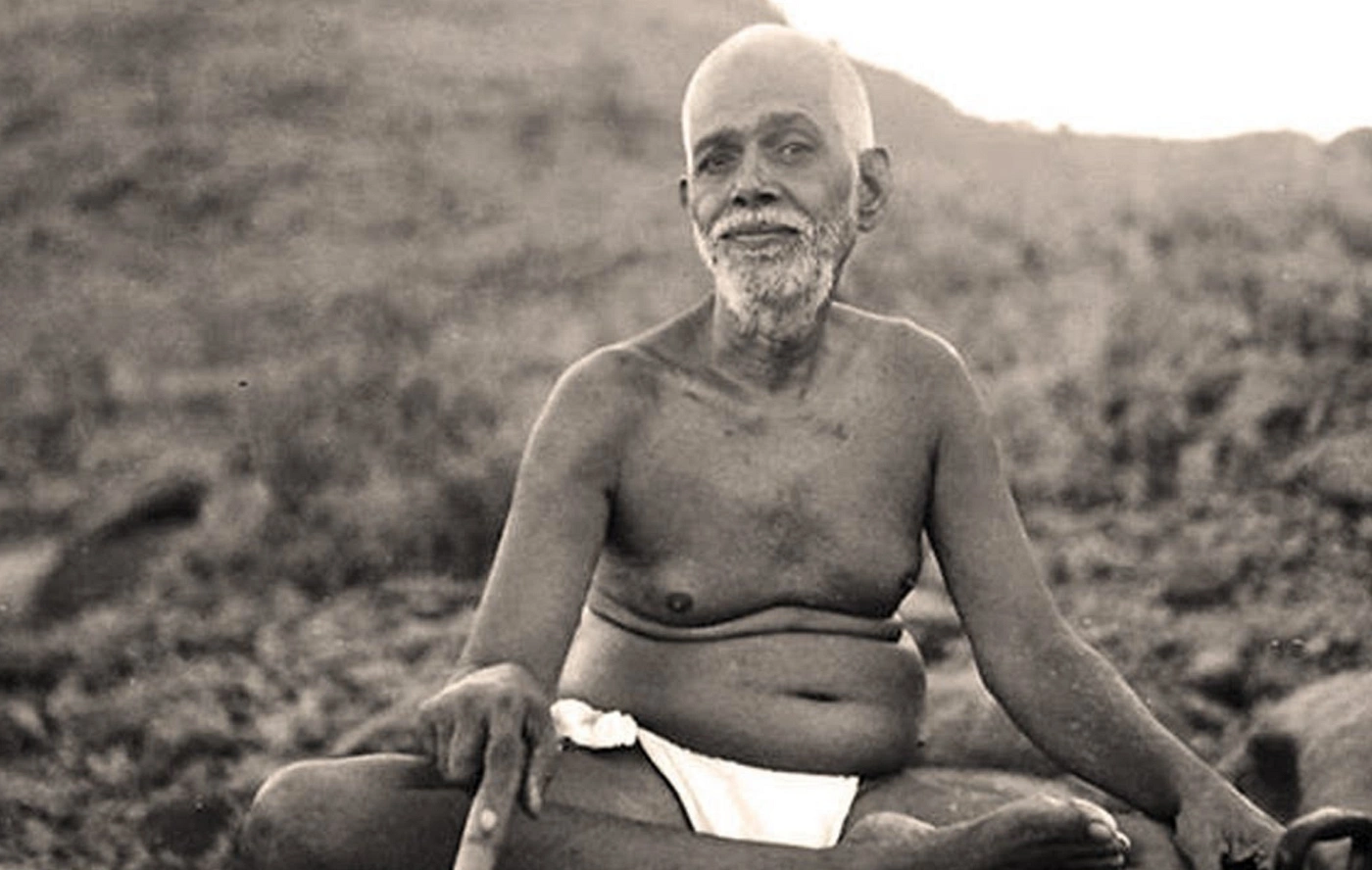
Ramana Maharshi expressed this beautifully through a parable. The mind, he said, is like a cow accustomed to wandering into neighboring fields. At first, even when offered good food in its own stable, it resists returning. But with gentle persistence, it gradually becomes accustomed to remaining there. Eventually, even when released, it no longer wishes to wander.
“So it is with the mind,” Maharshi says. “Once it finds happiness within, it will not turn outward.”
For Maharshi, effort is not struggle, but a gentle invitation to return home.
[1] The Yarkon River flows through Tel Aviv and empties into the Mediterranean Sea.